Many simulation projects are doomed to failure from the outset due to poor planning. Undefined objectives, unrealistic expectations and a general lack of understanding of requirements frequently result in frustration and disappointment. If a simulation project is to be successful, a plan must be developed which is realistic, clearly communicated and closely followed. Planning a simulation study involves the following sub tasks:
Preparing a Simulation Specification
Developing a Budget and Schedule
Each of these tasks is discussed in the following.
With a basic understanding of the system operation and an awareness of the issues of concern or interest, one or more objectives can be defined for the study. Simulation should only be used if an objective can be clearly stated and it is determined that simulation is the most suitable tool for achieving the objective. Defining an objective does not necessarily mean that there needs to be a problem to solve. A perfectly valid objective may be to see if there are, in fact, any unforeseen problems. Common types of objectives for a simulation study include the following:
Defining the objective should take into account what the ultimate intended use of the model will be. Some models are built as “throw-away” models to be used only once and then discarded. Other models are built to be used on an ongoing basis for continued “what-if” analyses. Some models need only provide a quantitative answer. Others require realistic animation to convince a skeptical customer. Some models are intended for use by only the analyst. Other models are intended for use by managers with little simulation background and must be easy to use. Some models are used to make decisions of minor consequence. Other models are relied upon to make major financial decisions.
Realizing the objectives of a simulation, you should consider both the purpose as well as the intended use of the model. The following questions should be asked when defining the objectives of the study:
Why is the simulation being performed?
Who will be using the model?
To whom will the results of the simulation be presented?
What information is expected from the model?
Is this a “throw-away” model?
How important is the decision being made?
Equally as important as defining objectives is identifying the constraints under which the study must be conducted. It does little good for simulation to solve a problem if the time to do the simulation extends beyond the deadline for applying the solution, or if the cost to find the solution exceeds the benefit derived. Objectives need to be tempered by the constraints under which the project must be performed such as the budget, deadlines, resource availability, etc. It is not uncommon to begin a simulation project with aspirations of developing an impressively detailed model or of creating a stunningly realistic animation only to scramble at the last minute, throwing together a crude model that barely meets the deadline.
Constraints should not always be viewed as an impediment. If no deadlines or other constraints are established, there is a danger of getting too involved and detailed in the simulation study and run the risk of “paralysis from analysis.” The scope of any project has a tendency to shrink or expand to fill the time allotted.
In identifying constraints, anything that could have a limiting effect on achieving the desired objectives should be considered. Specific questions to ask when identifying constraints for a simulation study should include the following:
What is the budget for doing the study?
What is the deadline for making the decision?
What are the skills of those doing the study?
How accessible is the input data?
What computer(s) will be used for the study?
With clearly defined objectives and constraints, the simulation requirements can be specified. Defining a specification for the simulation is essential to projecting the time and cost needed to complete the study. It also guides the study and helps set expectations by clarifying to others exactly what the simulation will include or exclude. A specification is especially important if the simulation is being performed by an outside consultant so that you will know exactly what you are getting for your money. Aspects of the simulation project to be contained in the specification should include the following:
Each of these specification criteria will be discussed in the following pages.
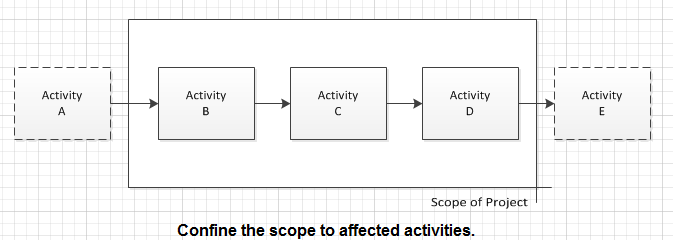
The following figure illustrates how the scope of the model should be confined to only those activities whose interactions have a direct bearing on the problem being studied. Upstream and downstream activities that do not impact the performance measure of interest should be omitted from the model. In the following figure, since the output rate from activity A is predictable, it can be modeled as simply an arrival rate to activity B. Since activity E never constrains output from activity D, it can also be ignored.
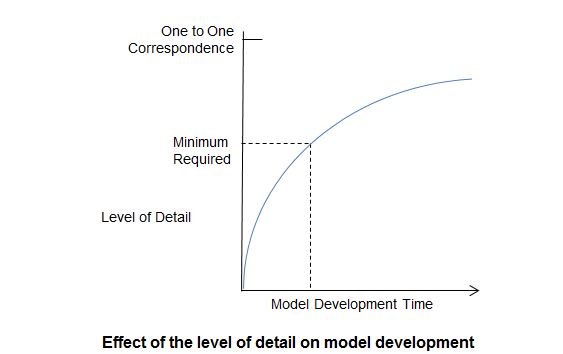
Unlike the model scope which affects only the size of the model, the level of detail affects model complexity as well as model size. Determining the appropriate level of detail is an important decision. Too much detail makes it difficult and time consuming to develop a valid model. Too little detail may make the model too unrealistic by excluding critical variables. The following figure illustrates how the time to develop a model is affected by the level of detail. It also highlights the importance of including only enough detail to meet the objectives of the study.
The level of detail is determined largely by the degree of precision required in the output. If only a rough estimate is being sought, it may be sufficient to model each activity by its time, rather than specific details making up the activity. If, on the other hand, details such as downtimes or move times have an appreciable effect on the outcome of the model, they should be included.
The required degree of accuracy can have a significant impact on the time and effort required to gather data. It often has little impact, however, on the model building time since a model can be built with estimated values that can later be replaced with more accurate values. Output precision is often governed by the degree of accuracy of the model.
For studies in which improvements to an existing system are being considered, it is often helpful and effective to model the current system as well as the proposed system. The basic premise is that you are not ready to make improvements to a system until you understand how the current system operates. Information on the current system is easier to obtain than information on areas of change. Once a model of the current system is built, it is often easier to visualize what changes need to be made for the modified system. Both systems may even be modeled together in the same simulation and made to run side by side. During the final presentation of the results, being able to show both “as is” and “to be” versions of the system effectively demonstrates the impact changes can have on system performance.
With objectives and constraints clearly defined and a specification prepared identifying the work to be performed, a budget and schedule should be developed projecting the expected cost and time for completing the simulation project. Obviously, the time to perform a simulation project will vary depending on the size and difficulty of the project. If data is not readily available, it may be necessary to add several additional weeks to the project. A small project can take two to four weeks while large projects can take two to four months. A simulation schedule should be based on realistic projections of the time requirements keeping in mind the following:
While it may have initially been determined that simulation is a suitable tool for achieving the objective, the decision to use simulation may need to be reconsidered in light of projected cost and time estimates. Simulation may be a good solution to the problem at hand, but if the time or the cost of doing the project outweighs the anticipated benefits, either an alternative solution may need to be explored or the objectives may need to be modified to cut down on the level of effort required.

|
© 2012 ProModel Corporation • 556 East Technology Avenue • Orem, UT 84097 • Support: 888-776-6633 • www.promodel.com |